A promo video of the new brick-built Nintendo collaboration has some people confused as to what your $60 will buy you.
No, of Course You Can’t Actually Play the New Lego Game Boy

A promo video of the new brick-built Nintendo collaboration has some people confused as to what your $60 will buy you.

Ambiq Micro, a 15-year-old manufacturer of energy-efficient chips for wearable and medical devices, closed its first day of trading on Wednesday at $38.53 a share, a 61% increase from the $24 IPO price the company set the previous day.
The success of the IPO signals strong investor demand in the public market for new small-cap companies benefiting from AI innovation.
Ambiq closed its first day as a public company with a valuation of $656 million (excluding employee options). This represents a significant increase from its last private funding valuation of $450 million in 2023, according to PitchBook.
Ambiq has pitched itself as well-positioned to capitalize on the growth driven by AI. “Because we’re so low energy, we can put more intelligence and more AI on board” of edge processors, the company’s CTO Scott Hanson told TechCrunch.
For the three months that ended March 31, Ambiq posted a net loss of $8.3 million against revenues of $15.7 million, the company’s S1 filing shows. The Q1 results mark a slight improvement from the first quarter of 2024, when the company reported a $9.8 million loss on $15.2 million in revenue.
Kleiner Perkins and EDB Investments, a Singaporean state-backed entity, are the largest outside backers of Ambiq, according to the filing.
Wen Hsieh, who was a general partner at Kleiner Perkins until 2023, first backed Ambiq when the company raised its Series C in 2014. Hsieh also invested in Ambiq after he launched his own venture firm, Matter Venture Partners, two years ago.
Techcrunch event
San Francisco
|
October 27-29, 2025
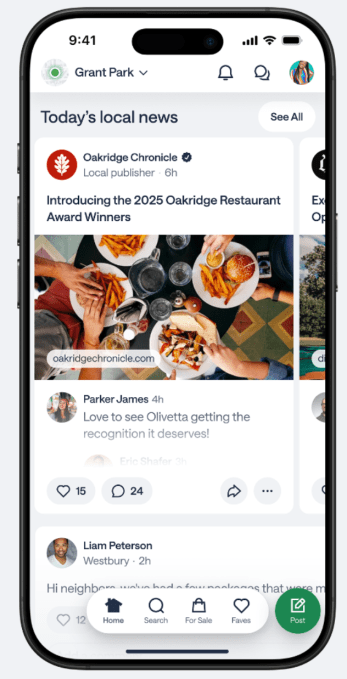
Neighborhood social app Nextdoor is launching a redesigned version of its service that it’s calling the “new Nextdoor.” The app is adding local news, real-time alerts, and an AI-powered feature called “Faves” that’s designed for discovering local businesses and spots. Nextdoor has also updated its overall design to look more contemporary.
Launched 15 years ago, Nextdoor has long served as a popular platform for neighborhood conversations, helping users connect over things like recommendations for plumbers and suggestions for nearby places to eat. But eventually, its growth stalled and engagement declined as the platform became associated with posts containing misinformation and racism.
Now, the company is looking to turn things around and attract more users by making its platform more helpful, useful, and timely. With this redesign, Nextdoor is looking to increase the quality and quantity of local information on the platform, Nextdoor CEO and co-founder Nirav Tolia told TechCrunch.
To bring news to its platform, Nextdoor has partnered with 3,500 local publications across the United States, United Kingdom, and Canada. Notable outlets include the San Francisco Standard, The London Standard, and The Toronto Star.
Image Credits:Nextdoor
“The reason that this is so important for us is historically, Nextdoor has relied 100% on user-generated content, just the content that’s created by your neighbors,” Tolia said. “That’s been a great source of information. But, to really make sure if it’s happening in your neighborhood, we need to bring in local news as well. So this is the first time we’re letting third party publishers use our distribution.”
Tolia stated that these aren’t commercial agreements, as Nextdoor isn’t paying for the content, nor are the publishers paying the company. Additionally, Nextdoor isn’t hosting the content; it’s simply displaying a headline, a snippet, and an image, and directing traffic to the publications. Users will be able to discuss the news in a comments section under each post.
Tolia noted that publishers are just the first new type of content coming to Nextdoor, as the platform plans to allow small businesses, schools, and organizations to have native presences in the app in the future as well.
Techcrunch event
Boston, MA
|
July 15
In terms of the new alerts, Nextdoor now shows real-time updates on things like weather, traffic, power outages, storms, and wildfires. These alerts will appear on a dynamic neighborhood map, allowing neighbors to have timely conversations about safety and preparedness.
The service is partnering with Samdesk and Weather.com, which includes The Weather Channel app and Weather.com, to power these alerts.
Image Credits:Nextdoor
“When there’s something that is definitely worth paying attention to, we call that the yellow state, and we’ll put that alert right at the top,” Tolia said. “When there’s something critical, we call that the red state and it’ll take over the whole app, because at that point, you don’t care about the conversations neighbors are having about pickleball. You don’t really care about the new restaurant review that the local publishers put in. You need to get together with your neighbors and help save each other’s lives in some cases.”
Tolia noted that these alerts are hyper-localized because Nextdoor is built on a geospatial platform. So unlike Amber Alerts that are sent out to everyone in a certain location, Nextdoor says it can personalize its alerts down to the house. For example, if there’s a power outage, the app will only send the alert to the people whose power is out.
As for the launch of Faves, Tolia says recommendations from neighbors are more valuable than going on Google or ChatGPT when looking to find a local restaurant or a place to spend time with family over the weekend, which is why Nextdoor is launching the feature. The new Faves feature displays curated lists of recommendations, and also lets you ask specific questions to get suggestions.
“We have an LLM for every neighborhood where we’ve taken 15 years of neighbor conversations and we can now answer questions about that information in a really compelling way,” Tolia said. “So we have the first, as far as we know, the first truly local AI that’s powered by neighbor conversations.”
You can ask questions like, “What is the best place to hike with kids?” and receive a quick, summarized response that pulls information from posts from real users on Nextdoor. Underneath the summary, you can see and click through to the posts that the summary is referencing.
Image Credits:Nextdoor
“This content is proprietary to Nextdoor,” Tolia said. “We’ve never shared it. It’s not indexed by Google. It’s not available on ChatGPT, and again, because we know where you live, we can target the information to you in the most relevant way.”
Tolia noted that Nextdoor’s unique value is in digitizing and capturing local word-of-mouth, the kind of hyperlocal information that isn’t available through platforms like Google or ChatGPT, because you can only get it from direct conversations.
“I give the funny example of, if you wanted to know all the lemonade stands that kids are operating in your neighborhood, you can’t go to Google Maps and find that,” Tolia said. “You can’t go to ChatGPT and ask that question, right? The only way is for you to ask your neighbors. And so that’s what Nextdoor is all about. So what are we going to do? We’re going to recommit to really making this feel hyperlocal. It’s really important for us to be seen less as a social network and more as a utility centric network.”

CNETThe Wentworth tournament is set to provide a big indicator of how this month’s Ryder Cup may play out.The Wentworth…