Illegal rent hikes by landlords during the crisis are prompting public outrage. Here’s what to know.
Don’t Fall Victim to Rental Price Gouging. Housing Resources for LA Wildfire Evacuees

Illegal rent hikes by landlords during the crisis are prompting public outrage. Here’s what to know.
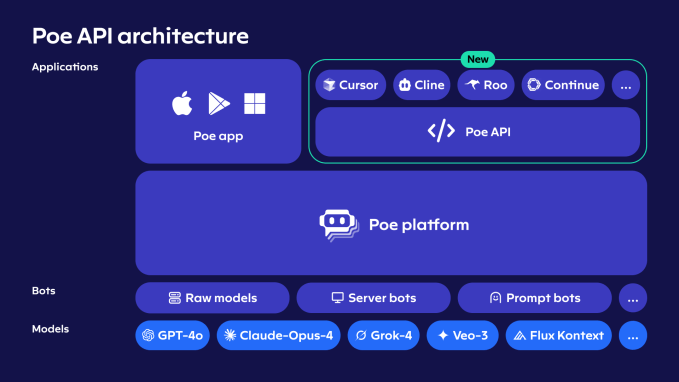
Quora’s AI platform Poe announced on Thursday that it’s releasing an API that allows developers to easily access different models or bots for their own applications.
The API doesn’t require a separate fee. Instead, usage is tracked via Poe’s existing point-based subscription plans, where each model call costs a set number of points. For instance, low-quality image generation through GPT-4o in a 1:1 aspect ratio and 1024 x 1024 size would cost 328 points.
Today, Poe’s plans include the $4.99 per month plan (10,000 points per day), the $19.99/mo plan (1 million points per month), the $49.99/mo plan (2.5 million points per month), the $99.99/mo plan (5 million points per month), and the $249.99/mo plan (12.5 million points per month).
Developers will also be able to buy additional points at a rate of $30 for 1 million tokens. Add-on tokens don’t come in a fixed package, so customers can pay any dollar amount to get tokens based on that rate.
Through this API, developers can power tools like Cursor, Cline, Continue, Roo, and any others that work with OpenAI-compatible chat completion APIs. The platform currently provides access to more than 100 models across voice, text, image, and video generation.
These multimodal models include Imagen 4, GPT Image 1, Flux Kontext, Seedream 3.0, Veo 3, Runway Gen 4 Turbo, Kling 2.1, ElevenLabs, and Lyria.
Image Credits:Quora
“Currently, we are working on allowing developers to take a private bot they have built on Poe and use that through an API. Plus, we are thinking about better key management for developers for the API product,” Gareth Jones, Poe’s product lead for creators and developers, told TechCrunch over a call.
Techcrunch event
San Francisco
|
October 27-29, 2025
While API provides a way for developers to use different models, Poe also offers tools aimed at consumers. Earlier this year, the company introduced a new way to allow users to easily create AI-powered apps. It also offers templates to build server bots, prompt bots, and image generation bots.
At the moment, developers will need to pick and manage model use manually. Jones said that the company will consider adding budget management functionality in the future, based on developer feedback.

Just a week after OpenAI announced it would offer ChatGPT Enterprise to the entire federal executive branch workforce at $1 per year per agency, Anthropic has raised the stakes. The AI giant said Tuesday it would also offer its Claude models to government agencies for just $1 – but not only to the executive branch. Anthropic is targeting “all three branches” of the U.S. government, including the legislative and judiciary branches.
The package will be available for one year, says Anthropic.
The move comes after OpenAI, Anthropic, and Google DeepMind were added to the General Services Administration’s list of approved AI vendors that can sell their services to civilian federal agencies. TechCrunch has reached out to Google to see if it plans to respond to Anthropic’s and OpenAI’s challenges in kind.
Anthropic’s escalation – a response to OpenAI’s attempt to undercut the competition – is a strategic play meant to broaden the company’s foothold in federal AI usage.
“We believe the U.S. public sector should have access to the most advanced AI capabilities to tackle complex challenges, from scientific research to constituent services,” Anthropic said in a statement. “By combining broad accessibility with uncompromising security standards, we’re helping ensure AI serves the public interest.”
Anthropic will offer both Claude for Enterprise and Claude for Government. The latter supports FedRAMP High workloads so that federal workers can use Claude for handling sensitive unclassified work, according to the company.
FedRAMP High is a stringent security baseline within the Federal Risk and Authorization Management Program (FedRAMP) for handling unclassified sensitive government data.
Techcrunch event
San Francisco
|
October 27-29, 2025
Anthropic will also provide technical support to help agencies integrate AI tools into their workflows, according to the company.
Anthropic, along with OpenAI, xAI, and Google, has been granted up to $200 million by the Department of Defense to leverage AI for national security, but the AI firm clearly hopes to integrate into a broader array of government work, including science research and health services. Anthropic noted in its press release that Claude is already being used at Lawrence Livermore National Laboratory to accelerate scientific discoveries, and also by the District of Columbia Department of Health to help residents access health services in multiple languages.
Anthropic says it is able to make such deployments because Claude “meets the government’s highest security standards.” Aside from being certified for FedRAMP High, customers can access Claude through their existing secure infrastructure via partnerships with AWS, Google Cloud, and Palantir, giving them more control over their data.
Anthropic’s multi-cloud access could give it an edge in the competition with OpenAI, whose current official FedRAMP High offering is tied to Azure Government Cloud only. While Azure is widely adopted in government, some government agencies and security teams might prioritize data sovereignty, infrastructure control, and the operational flexibility a multi-cloud strategy offers.
OpenAI is, however, actively working to reduce its reliance on Azure so it can embrace a more diversified infrastructure approach.
Smoke detectors can protect your home and family in the event of an emergency. Here are CNET’s expert recommendations.